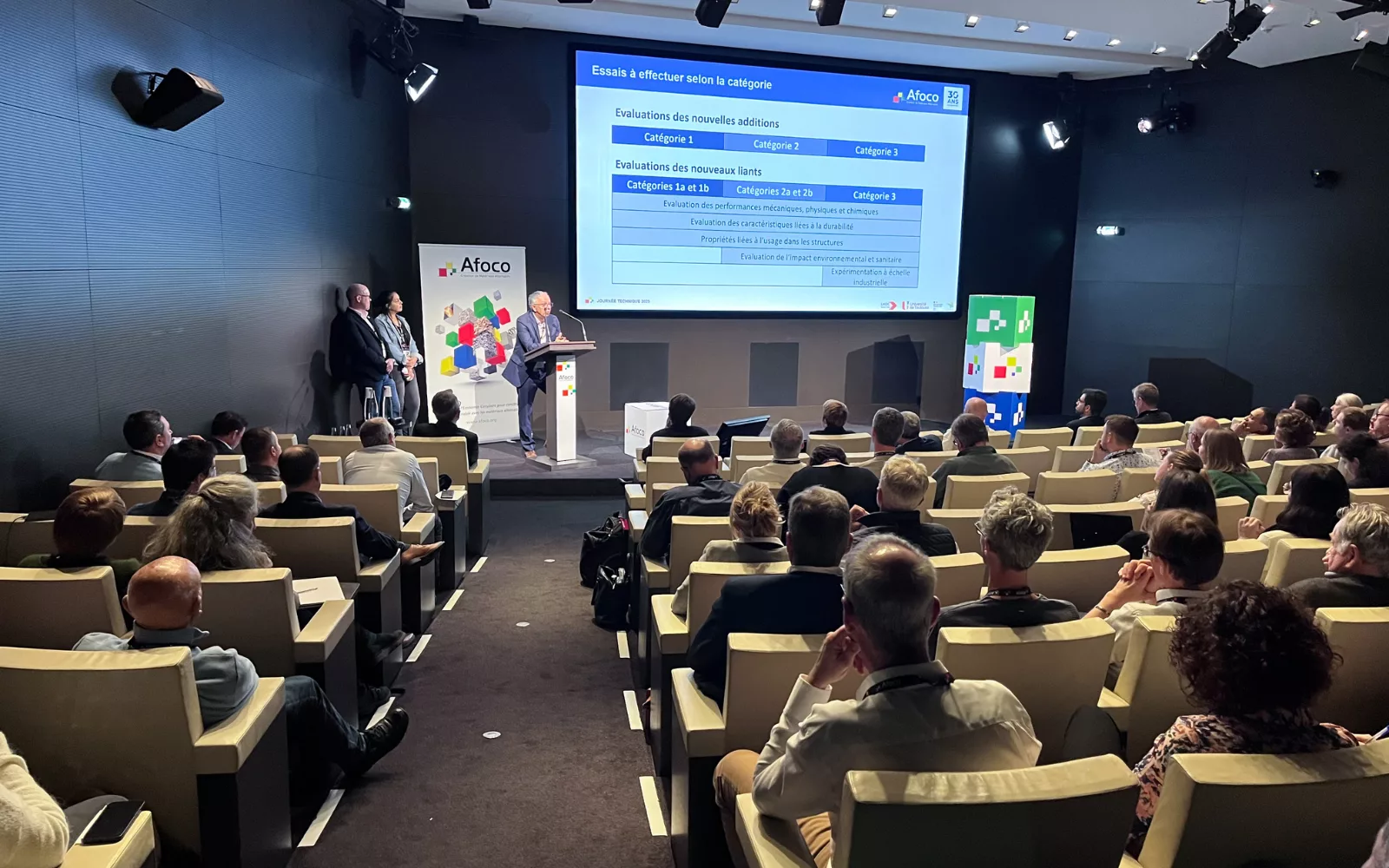
At the AFOCO 2025 Technical Day, Rachida IDIR, CEREMA researcher, Martin CYR, LMDC Toulouse Professor of Universities at LMDC TOULOUSE and Loïc DIVET, consultant, LDIVET Conseil presented an essential tool for the low-carbon transition: FD P 18-484, designed to guide the evaluation of new binders and additions for concrete.
This benchmark provides a methodological framework to support innovation while ensuring the performance, safety and durability of materials. It is fully part of a transformational dynamic of the sector, where the emission reduction requirement leads to rethinking practices and integrating more sustainable solutions.
A methodological framework to secure innovation
The FD P 18-484 is now a reference for evaluating new binders and additions. It proposes a harmonised approach to:
- precisely characterize the materials,
- assess their mechanical performance and durability,
- to anticipate their environmental and health impacts,
- If necessary, prepare for future integration into a normative framework.
This methodology responds to a need: to support innovation while maintaining a level of confidence equivalent to that of traditional cements.
Clear classification to better adapt requirements
The paper introduces a classification of new binders and additions according to their degree of innovation and their distance from already standardized materials. This approach allows the level of testing and verification to be adjusted, thus avoiding over- or under-evaluation of performance.
Three large families are defined for binders and additions, ranging from materials close to standard products to radically new solutions, such as:
- alternative binders using industrial by-products,
- additions from activated natural resources,
- binders based on distinct physico-chemical principles (geopolymers, carbonate binders, etc.).
Practical examples of application
The presentation also highlights several case studies illustrating the implementation of the FD P 18-484 methodology:
- reduction of clinker rate via new mixtures of recognized constituents,
- upgrading of non-standard pozzolanic materials (crushed glass, biomass ash),
- evaluation of innovative binders based on alternative chemistry.
These examples demonstrate the robustness of the booklet and its usefulness in supporting industrial and academic projects aimed at developing credible and qualified low carbon solutions.
A structural tool for low carbon concrete transition
With the rise of environmental regulations (RE2020) and the ambitions set by the European Green Pact, concrete players need reliable tools to integrate new materials while maintaining a high level of performance.
As such, the FD P 18-484 appears to be a methodological pillar, making it possible to secure innovation approaches and to promote the dissemination of more sustainable practices.
View the full presentation
Find the full presentation on our website : Click here