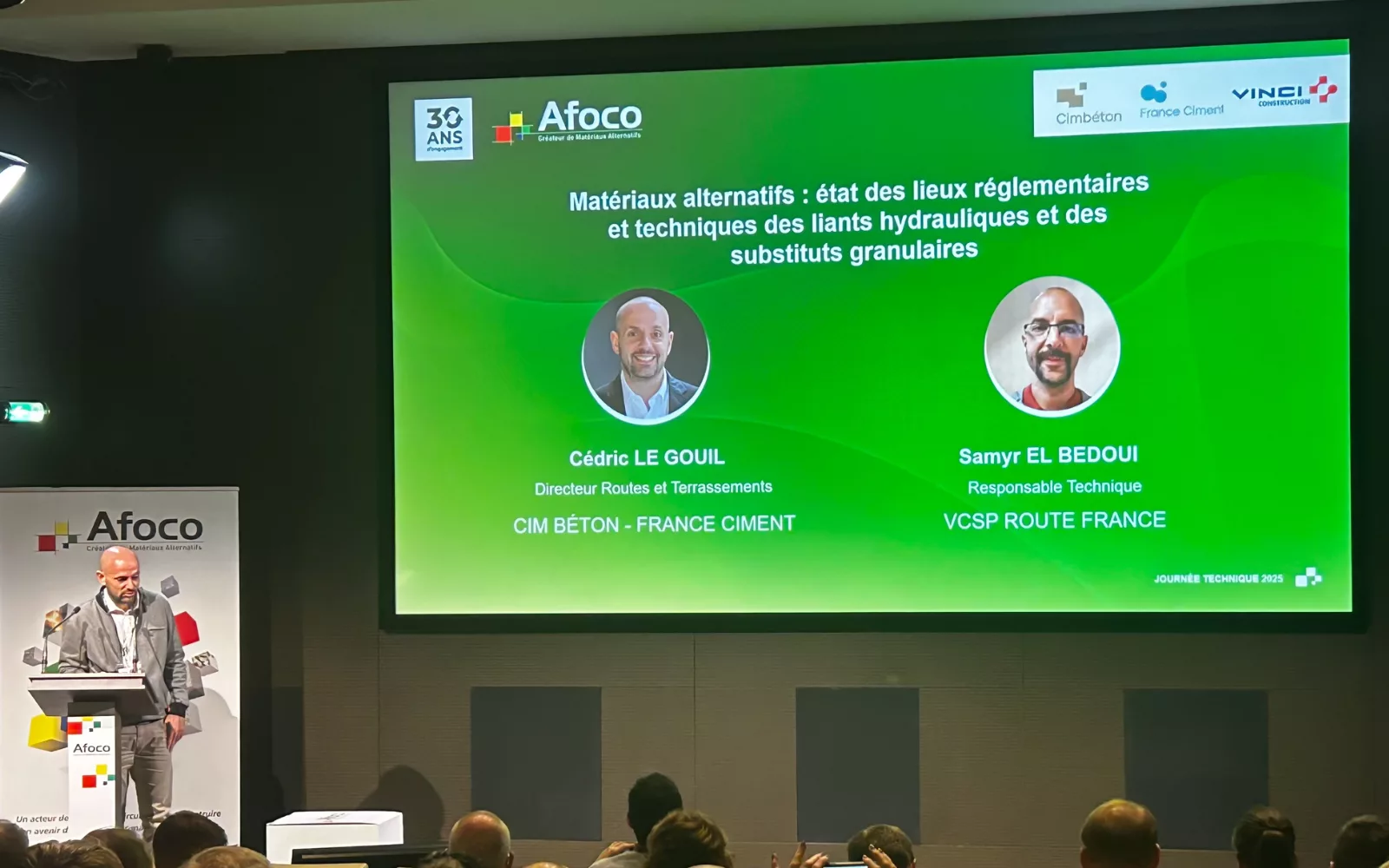
At the AFOCO 2025 Technical Day, Samyr EL BEDOUI, Technical Manager, VCSP Route France and Cédric LE GOUIL, Director Roads and Terraces, CIMBÉTON – France Cementthe development of the regulatory and technical framework for hydraulic binders and granular substitutes.
A cement sector in accelerated transformation
France Cement, which represents all producers of hydraulic binders, recalled the structuring role of the sector in the ecological transition. The cement industry is already recovering more than 3.3 million tonnes of waste and by-products per year, helping to preserve natural resources while reducing CO2 emissions through increasing substitution of fossil fuels.
This dynamic is progressing rapidly: by 2024, 55% of the energy mix of cement plants came from alternative fuels, and the target announced for 2030 is to reach 80%, a major scale change for the sector.
Cimbéton, the technical hub of France Cement, supports this transformation by providing professionals with multiple tools: guides, computer software, RE2020 resources, feedback from field experience... a complete ecosystem designed to facilitate the adoption of innovative materials.
Evolution of cement standards: diversification, decarbonization and new constituents
The presentation stressed the importance of recent normative developments concerning cements and hydraulic binders. The EN 197 standard has seen a considerable extension: from 27 standard products in 2012, it now has 38, incorporating reduced clinker rate formulations and a growing variety of alternative constituents.
Additions such as slag, fly ash, silica smoke, calcined shale and now recycled concrete fines (introduced by EN 197-6 of 2023) greatly reduce the carbon footprint of cements. Some have very low emissions from the clinker, illustrating significant potential gains for decarbonization in the sector.
The next revision of EN 197-1, expected by 2027, will go even further: integration of CEM II/C-M and CEM VI cements, increase in the rates of alternative constituents, acceptance of new sources of additions (fireplace ash, calcined clays), and introduction of environmental requirements in performance declarations.
On the road hydraulic binders side, an equivalent revision is planned to integrate recycled concrete fines and adjust performance thresholds, while also introducing environmental criteria.
The structural role of Europe: SuStacEM and the standardisation of tomorrow
Speakers also presented SuStacEM, a European programme led by CEN/TC51 and funded by the European Union. The aim is to create a collaborative platform to identify, evaluate and standardize future components that will decarbonize cements. The project explores still unexploited materials: steel dairy from different sectors, recycled glass, tailings, dredging sludge and materials from construction/demolition.
This European movement shows that standardisation itself becomes a vector of innovation, capable of accompanying the rapid evolution of industrial processes while securing uses.
Granular substitutes: a framework for use that strengthens
Beyond binders, the presentation made a precise point on granular alternative materials, now gradually integrated into earthworks, foundations and layers of form. The new texts, including EN 16907-2 and the work of TC396, harmonize classifications and usage criteria, taking into account:
- the nature of the deposits,
- observed performance,
- feedback,
- and environmental compatibility.
The evolution of DTU 13-3 illustrates this transition: materials are now described in finer terms, with partial exclusions and acceptability thresholds based on environmental or technical risk analysis.
The environmental guides are also being revised, with the development of a guide for development.
Thus, although some materials remain explicitly prohibited, the industry is moving towards a structured integration logic, where alternative materials gradually become recognized and controlled solutions.
A changing industry, guided by the norm and innovation
The presentation France Cement and VCSP Route France highlighted a fundamental trend: standardization, long perceived as a restriction framework, is now becoming a lever of transformation.
The diversification of cements, the integration of recycled components, the rise of alternative materials, and European projects such as SuStaCEM demonstrate a structured movement towards a more sustainable but also more demanding sector in terms of control, traceability and qualification.
View the full presentation
Find the full presentation on our website : Click here