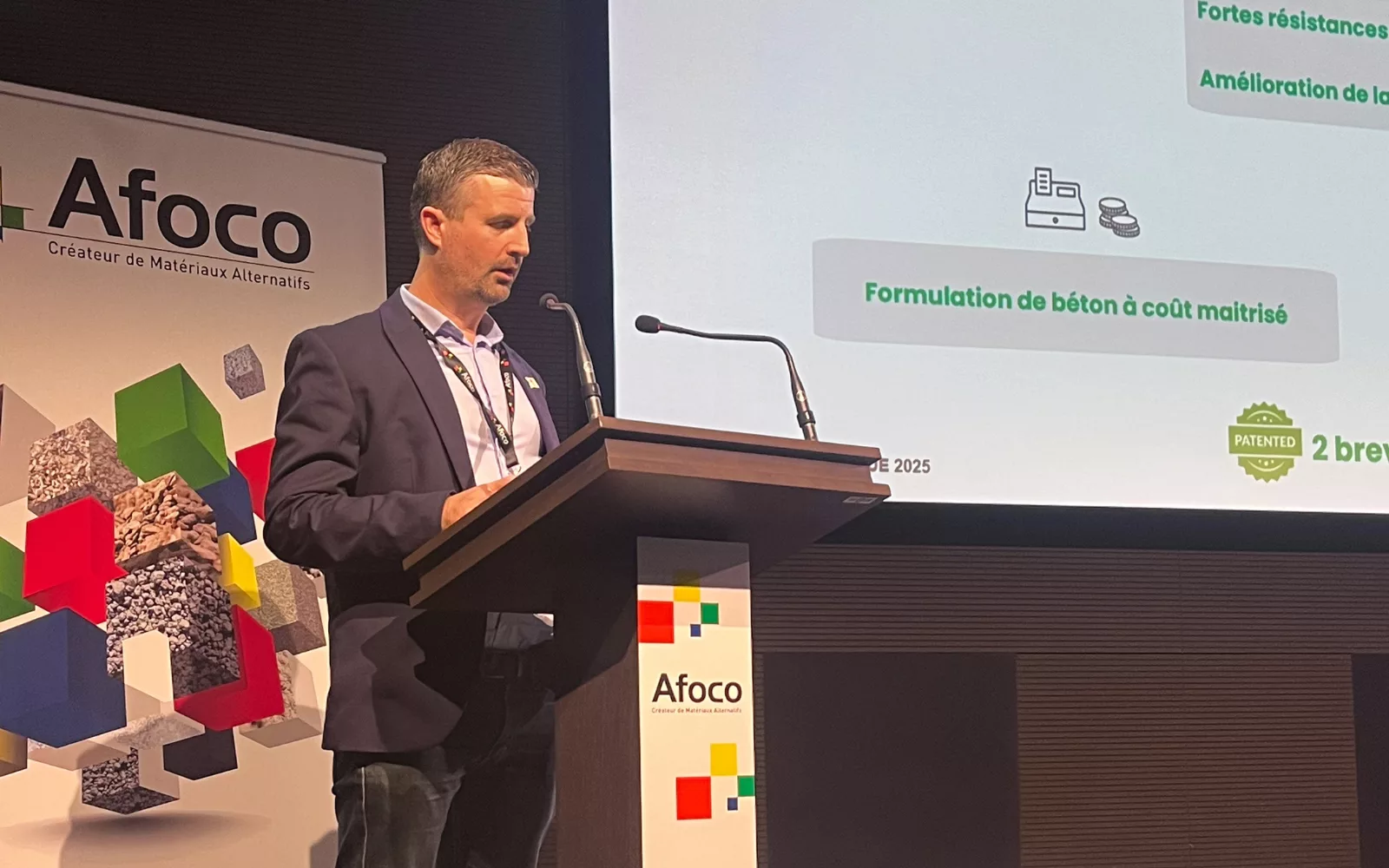
At the AFOCO 2025 Technical Day, Samy Dreux, co-founder of Geoclay, presented an innovation that arouses a keen interest in the sector: the valorisation of co-products from quarries made of low carbon binders for concrete.
A solution that fully fits into the current challenges of construction decarbonization, while concrete, the second most used material in the world after water, accounts for almost 8% of global CO2 emissions.
The challenge: reducing the carbon impact of concrete
Cement, an essential component of concrete, accounts for 98% of carbon emissions from the material. It is therefore on this fundamental brick that the majority of the environmental footprint reduction potential rests.
In an ever more demanding regulatory environment, carbon tax by 2030, national targets for reducing CO2 in construction and industry, carbon neutrality by 2050, material innovation becomes a key lever.
Geoclay: activated clay with -90 % CO2 vs clinker
The solution developed by Geoclay is based on activated clay, used as a substitute for clinker, whose production is extremely carbonised.
Result: -90 % CO2 emissions compared to traditional clinker, while maintaining comparable mechanical performance in concrete formulations
This technology, protected by two patents, offers a concrete response to the needs: a low carbon binder, industrially reproducible, capable of integrating into existing formulation practices.
Performance validated by major construction players
At the end of 2024, Geoclay launched its first industrial production, accompanied by technical validation by several majors in the sector.
A typical concrete formulation incorporating Geoclay displays:
- a global binder of 300 kg/m3,
- about –50% CO2 emissions,
- very good mechanical resistance from 24 hours and 28 days .
These results place this solution among the most promising alternative binders currently available for BTP.
Multiple uses in construction and public works
Geoclay is compatible with a wide range of applications:
- foundations and civil engineering,
- superstructures,
- urban development,
- Art.
This versatility paves the way for gradual integration into low-carbon projects, whether public or private.
An ambitious and structuring implementation strategy
To support industrial deployment, Geoclay plans to rapidly increase its production capacity:
- 1st plant in Île-de-France (already operational),
- 2nd plant planned in Centre/IDF in 2028,
- Third plant in the southwest in 2027,
- international expansion with a Benelux establishment in 2030.
This strategy aims at national coverage, which is essential to secure low carbon binder supplies throughout the country.
Innovation at the heart of the low-carbon transition
The presentation of Samy Dreux showed how Geoclay fits into a broader dynamic:
- use of existing resources,
- drastic reduction of emissions,
- responses aligned with future regulatory constraints,
- rapid and credible industrialization.
GEOCLAY is an excellent example of the industry's ability to innovate to decarbonize without compromising performance, a strong expectation from contractors, industry and communities.
View the full presentation
Find the full presentation on our website : Click here