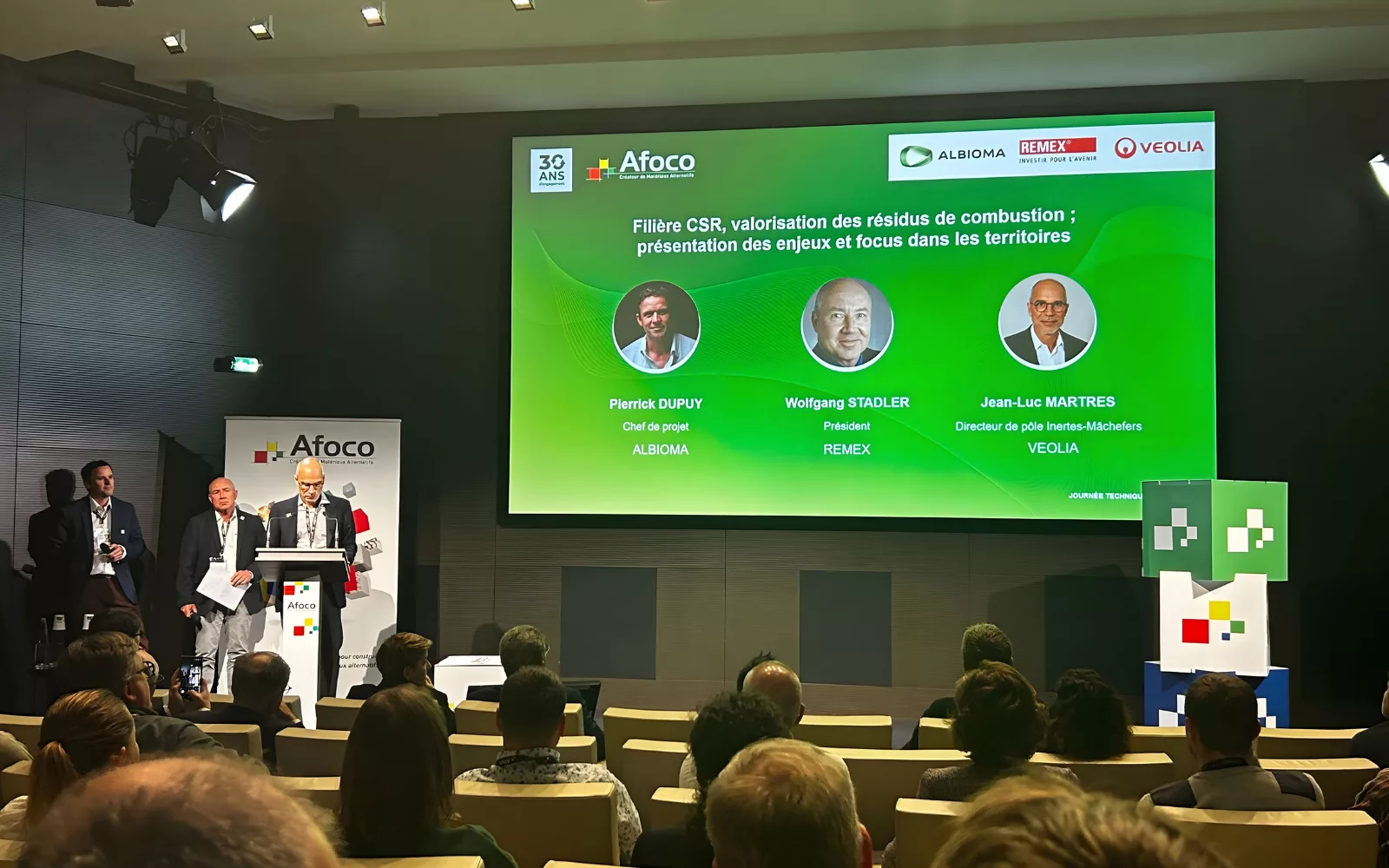
On the occasion of the AFOCO 2025 Technical Day, several experts, Pierrick Dupuy, Project Manager ALBIOM-H, ALBIOMA, Wolfgang Stadler, President, REMEX and Jean-Luc Martres, Director of Inertes-Mêchers Pole, VEOLIA, presented an in-depth review of the Fuels Solid Recovery (CSR) industry, as well as prospects for the recovery of combustion residues.
CSR: a major lever for energy transition and reduction of landfill
CSRs are generated from non-recyclable waste mainly from IBDs and EADs. Prepared for use as an alternative fuel, they help: reduce dependence on fossil fuels, reduce landfilling and create a new value chain within the circular economy. The sector is currently growing steadily, with nearly 1 million tonnes produced per year, and an ambition to reach 2.5 to 3 million tonnes by 2030.
- The presentation recalls the key elements of the French framework:
- AGEC law and European waste hierarchy,
- Low Carbon National Strategy,
- Orders of 23 May 2016 governing the preparation and combustion of CSRs,
- ICPE 2971 dedicated to CSR installations.
However, a key point remains:
SSR chewers do not yet have a dedicated regulation, unlike those from household waste (MIND).
A CEREMA methodological guide is being prepared to provide a technical basis and guide usage.
What combustion residues and potential for recovery?
The combustion of CSR generates three types of residues:
1. Chewing
- Heavy residues consisting of minerals and metals.
- High potential in civil engineering: road underlays, technical embankments...
2. Ash under boiler
- Intermediate residues not yet fully exploited.
- Potential uses in cements or building materials.
3. Filter ash
- Fine particles classified as hazardous waste.
- Need stabilization (vitrification, innovative treatments...).
- Knowledge of physico-chemical characteristics is a major challenge for the development of sustainable pathways.
Comparison with MIDNDs: similarities, differences and impacts
SSR chewers are distinguished by generally higher levels of chlorides and heavy metals. They also present the peculiarity of not having a specific regulatory framework to date, unlike the incineration of household waste. Finally, there is currently no dedicated technical guide to guide their use or use.
Similar to MIDNDs can be used as a basis, but important adjustments will be needed to ensure safe and consistent recovery.
Perspectives: structuring a strategic path
Three levers were identified to accelerate national structuring:
- Regulatory strengthening: publication of CEREMA guide, gradual integration into BTP standards.
- Pilot experiments: deployment of collaborative projects to test, validate and secure the recovery routes.
- Building a community of actors: industry, communities, ADEME: all have a key role to play in building a truly circular economy around CSR.
CSR is a pillar of the energy transition and waste reduction in France. Combustion residues should no longer be seen as constraints, but as resources to be valued through technological innovation, regulatory support and stakeholder collaboration.
🔗 View the full presentation
Find the full presentation on our website : Click here