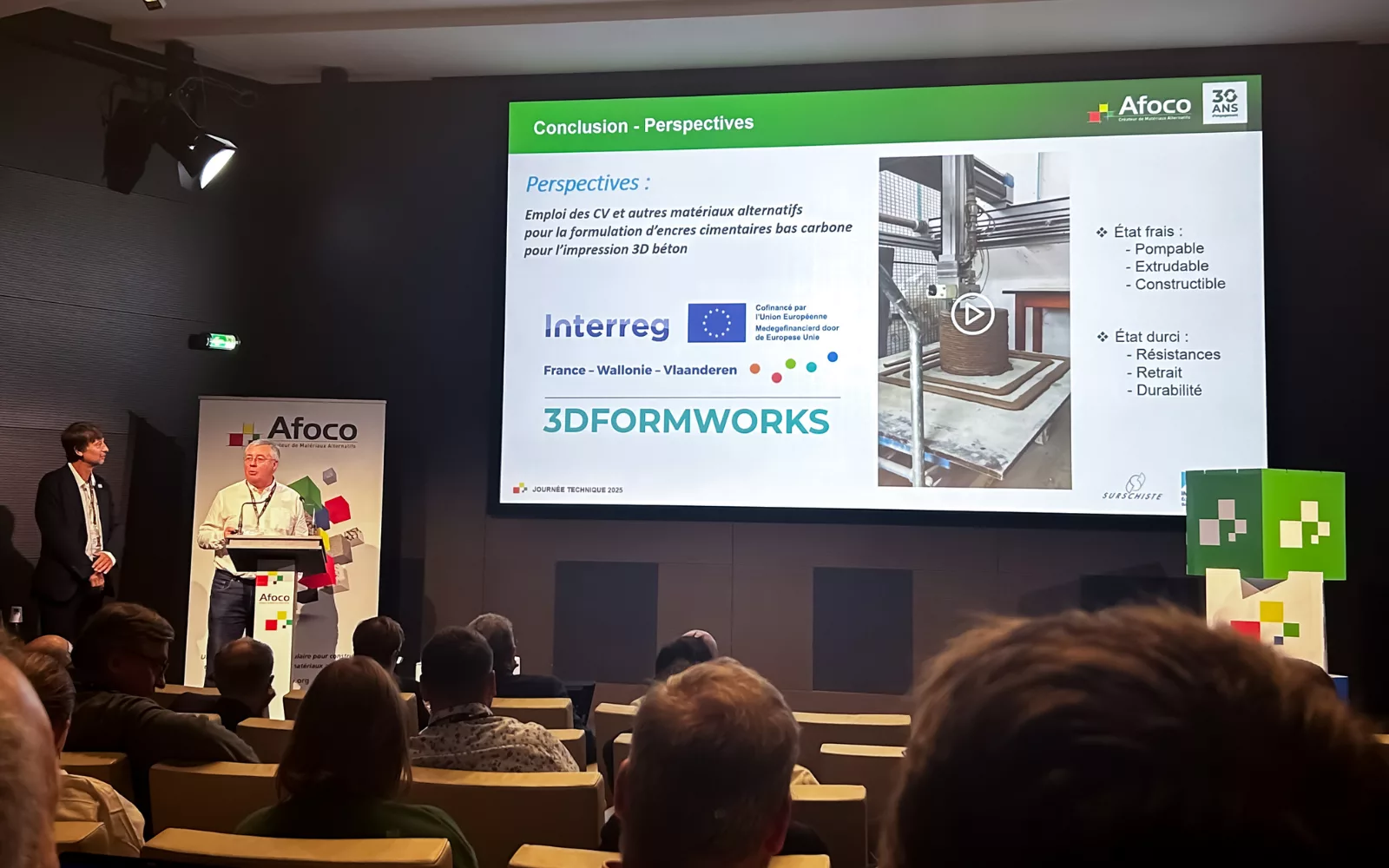
At the AFOCO 2025 Technical Day, David Bulteel, Teacher Researcher at IMT North Europe and Loïc Danest, Technical Director at Surschiste presented a methodology to better characterize the behaviour of coal fly ash from historical stocks. This work is part of a dynamic aimed at securing the use of these materials in concrete and hydraulic binders, while promoting low carbon practices.
A changing context: historic stocks become the main resource
In France, the availability of fresh fly ash from coal-fired power plants is declining sharply. Historical stocks thus become the main source of supply for their use in complementary critical materials in concrete, mortars or compound cements.
These materials must meet strict requirements:
- compliance with standards EN 450-1 and EN 450-2,
- constant performance,
- water demand control,
- Good responsiveness and durability.
Since 2006, Surschiste has had an EC certificate and a broad database for in-depth statistical analysis of the behaviour of these ashes.
Characteristics influenced by the history of materials
Stored ash has a high variability due to several factors:
- combustion technologies implemented over different periods,
- landfill conditions, sometimes critical,
- the time-related processes of hydration, carbonation or alteration.
If their overall chemistry remains stable, the responsiveness, mechanical performance and properties of fresh concrete may vary significantly. Hence the need for a fine characterisation methodology.
A revealing case study: the follow-up of a stock of 30,000 tonnes
Complete sampling and investigation was carried out on a large stock, including:
1. Quality control out of stock
Early analyses revealed significant differences in fire loss (LOI) between samples.
2. Laboratory investigation
Detailed measurements (LOI at 550°C and 1000°C, thermogravimetric analyses, total organic carbon, carbonate content, etc.) distinguished several components: unburned organic matter, calcium carbonate, bound water.
These results show that the Act can provide an inaccurate view of residual carbon, which is problematic for compliance with EN 450.
Increasing importance of total organic carbon (COT)
The work presented shows that the fire loss is not suitable for estimating the amount of carbon unburned in old ash.
The CEN proposes to introduce a new feature in EN 450-1: organic carbon (according to ISO 10694), which is more reliable and representative.
This will help to characterize stored ash better and avoid misinterpretations.
Towards new perspectives: responsiveness, low-carbon formulations and innovative applications
Several research avenues are now under development:
- Improve understanding of fly ash responsiveness
- The objective is to better link their physical parameters to concrete performance.
- Integrate all industrial processes
- Drying, grinding, classification, carbon separation: each step can influence the final properties.
- Developing low carbon solutions
The use of ash in cement inks for 3D printing, low carbon binders, stabilization/solidification of polluted soils, opens up new technical and environmental perspectives.
🔗 View the full presentation
Find the full presentation on our website : Click here