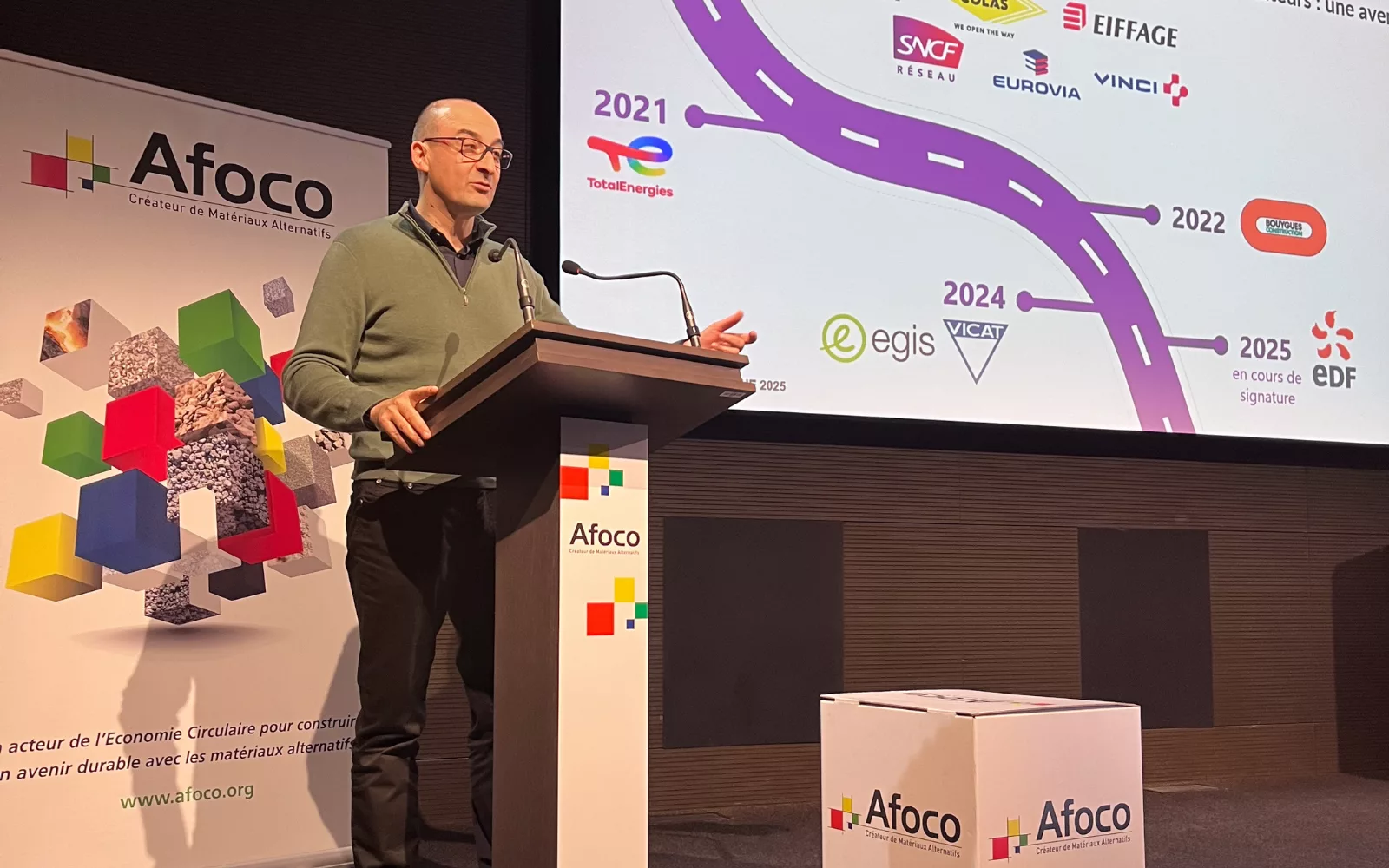
At the AFOCO 2025 Technical Day, François Olard, President of INFRA2050 and President of the FEREC Enterprise Foundation, has provided a clear and structured vision of the issues that are now going through the infrastructure and construction sector. His presentation goes back to the major transitions under way and the levers to be activated to collectively address the societal, climate and economic challenges of the coming decade.
A transition period that requires an ambitious and coherent R&I
The sector faces a cluster of transformations: economic, energy, digital, demographic and climatic transitions.
For François Olard, the key lies in a long-term, collaborative and multi-stakeholder research and innovation (R&I) strategy capable of structuring the sector's efforts on a sustainable basis.
Among the strong guidelines:
- Developing a stable long-term vision
- Strengthening public-private partnership research
- Better integrate the academic world into structuring projects
- Using federative ecosystems such as FEREC, IREX or INFRA2050
Infra2050: a structural competitiveness centre for the Public Works sector
The presentation recalls the central role of the Infra2050 competitiveness pole, which links actors to a strategy articulated in three thematic pillars and a cross-cutting digital axis:
- Resilient territories and infrastructure
- Carbon-free materials and infrastructure
- Decarbonizing uses and infrastructure
- Transverse axis : Digital
FEREC: Support, federate and enhance collaborative research
The FEREC Enterprise Foundation plays a strategic role in funding and supporting research projects. Since 2018, these are:
- 64 projects supported for a cumulative funding of 2.4 M€
- A wide range of public and academic actors benefiting from the
- One objective: to initiate and structure large-scale projects, which could move towards national programmes or funding.
Each year, FEREC launches a thematic call for projects. Recent editions have focused on:
- decarbonisation,
- IIA applied to infrastructure,
- hydraulic infrastructure,
- biodiversity,
- fine rail lines of the territory,
- safety and prevention in the construction sector.
In 2025, the call for projects revolved around four axes, including carbon sequestration in the construction and adaptation of territories to climate change
An action-oriented vision and the collective
The presentation stresses the need for a collective, coherent and structured approach, such as the joint action of Infra2050 and the FEREC Foundation.
The ecological transition and the transformation of infrastructure can only be successful if the sector strengthens the initiation, collaboration and dissemination of knowledge.
🔗 Consult the full presentation
See the detailed presentation: Click here