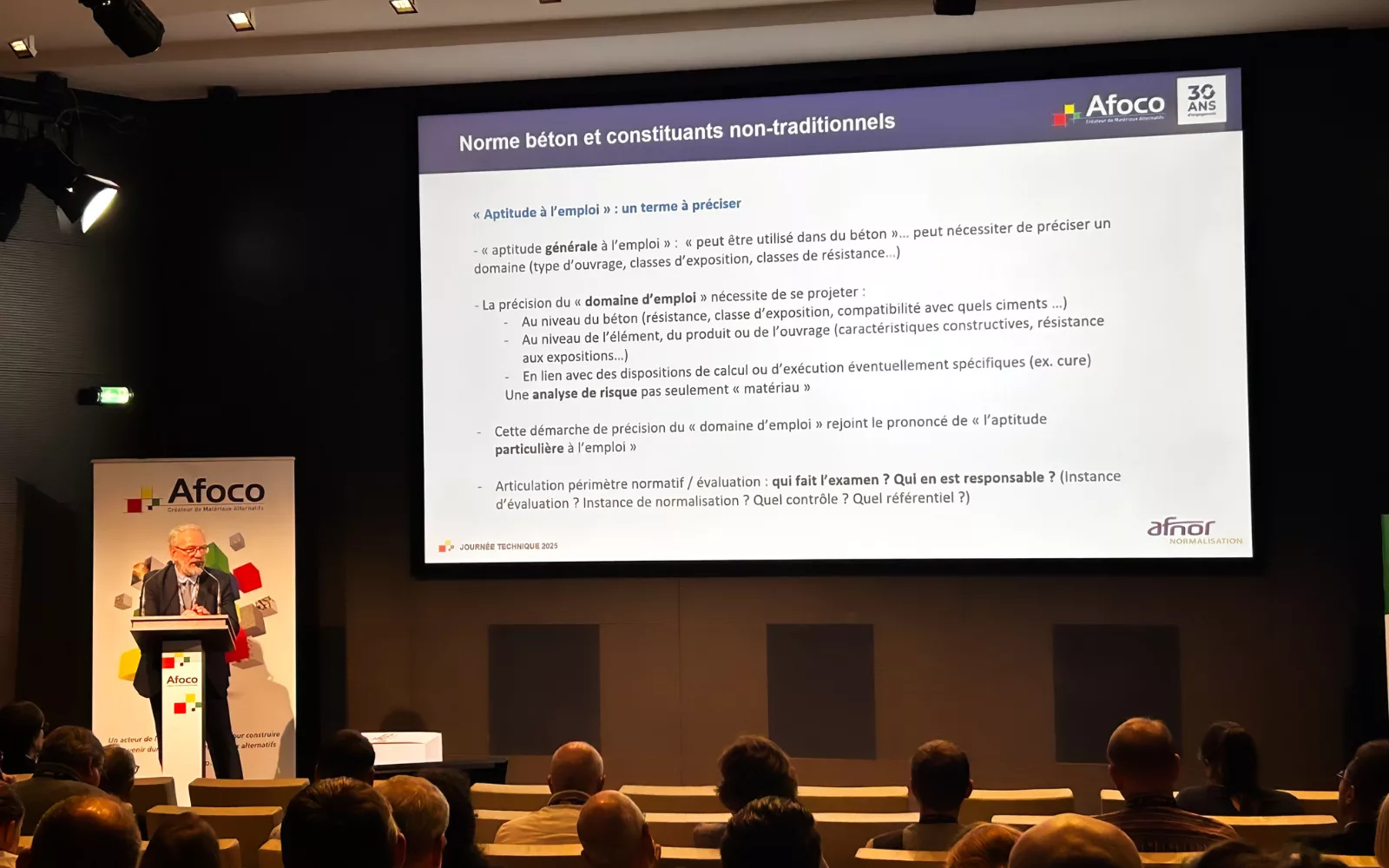
During the Technical Day, François ALLLEMONDE, Chairman of the AFNOR P18B (concrete) and P18C (concrete) commissions, and representative of Gustave Eiffel Universityproposed an in-depth intervention on the evolution of the concrete standard against the integration of non-traditional components.
His presentation shed light on the technical, normative and organisational issues that make it possible to use these new materials in a context of accelerated environmental transition.
A normative framework under stress between innovation and security
In a context where the industry is under high pressure to decarbonize rapidly, low carbon binders (LBC) and additions from alternative resources — activated clays, recycled girls, glass powders, biochar, valued industrial by-products — appear as immediate levers.
However, as François TALLEMONDE recalled, their integration faces several technical and regulatory constraints:
The NF EN 206 standard is historically based on:
- proven cement combinations,
- a massive feedback to demonstrate service sustainability,
- conditions guaranteeing a presumption of insurability, essential for operational actors.
The introduction of new constituents calls into question these foundations, in particular in terms of:
- kinetics of hydration,
- mechanical resistance at a young age,
- durability vis-à-vis exposure classes (XC, XS, XF, etc.),
- compatibility with conformity control methods.
Conflicting injunctions between speed and rigour
Governments and contractors demand rapid innovation, but standardization requires:
- evidence,
- long cycle tests,
- a complete risk analysis,
- reliable service data.
This tension between environmental emergency and the need for robustness structure all technical debates.
The future NF EN 206+A2/CN:2025: a balanced architecture
François ALLLEMONDE presented the balanced position adopted for the next version of the standard, which introduces a structured system of integration of non-traditional constituents.
A central pillar: the technical specification FD P 18-484
This booklet is based on a detailed methodology for a complete technical dossier, including:
- physico-chemical characteristics of the constituent,
- manufacturing consistency and traceability,
- compatibility with existing cements,
- durability tests in relation to exposure classes,
- behaviour in formulation, implementation and cure,
- justification for short- and long-term performance.
Three assessment schemes under the new standard
- Constituents already having a product standard → easy integration
- Constituents benefiting from an ETE (European Technical Assessment) → framed recognition
- Constituents without standard or ETE → mandatory technical file, based on FD P 18-484
In the latter case, the standard provides that concrete using these constituents is not compliant until the associated assessment benchmark is formally established. This marks a major step forward in terms of clarity and security.
Towards a specific distinction: general aptitude vs. particular aptitude for employment
The presentation also stressed a fundamental clarification:
- General suitability for use: the component's capacity to be used in concrete under generic conditions.
- Special suitability for use: validity for a specific field of application (type of work, exposure class, mechanical performance, implementation constraints).
🔗 View the full presentation
Find the full presentation on our website : Click here