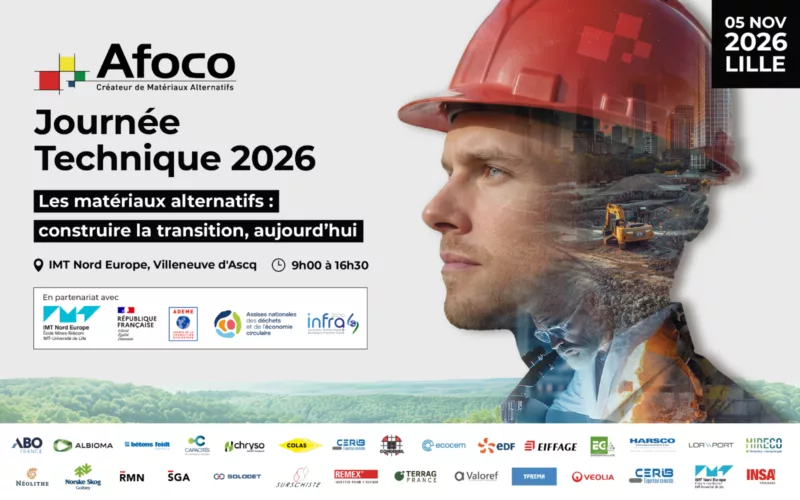
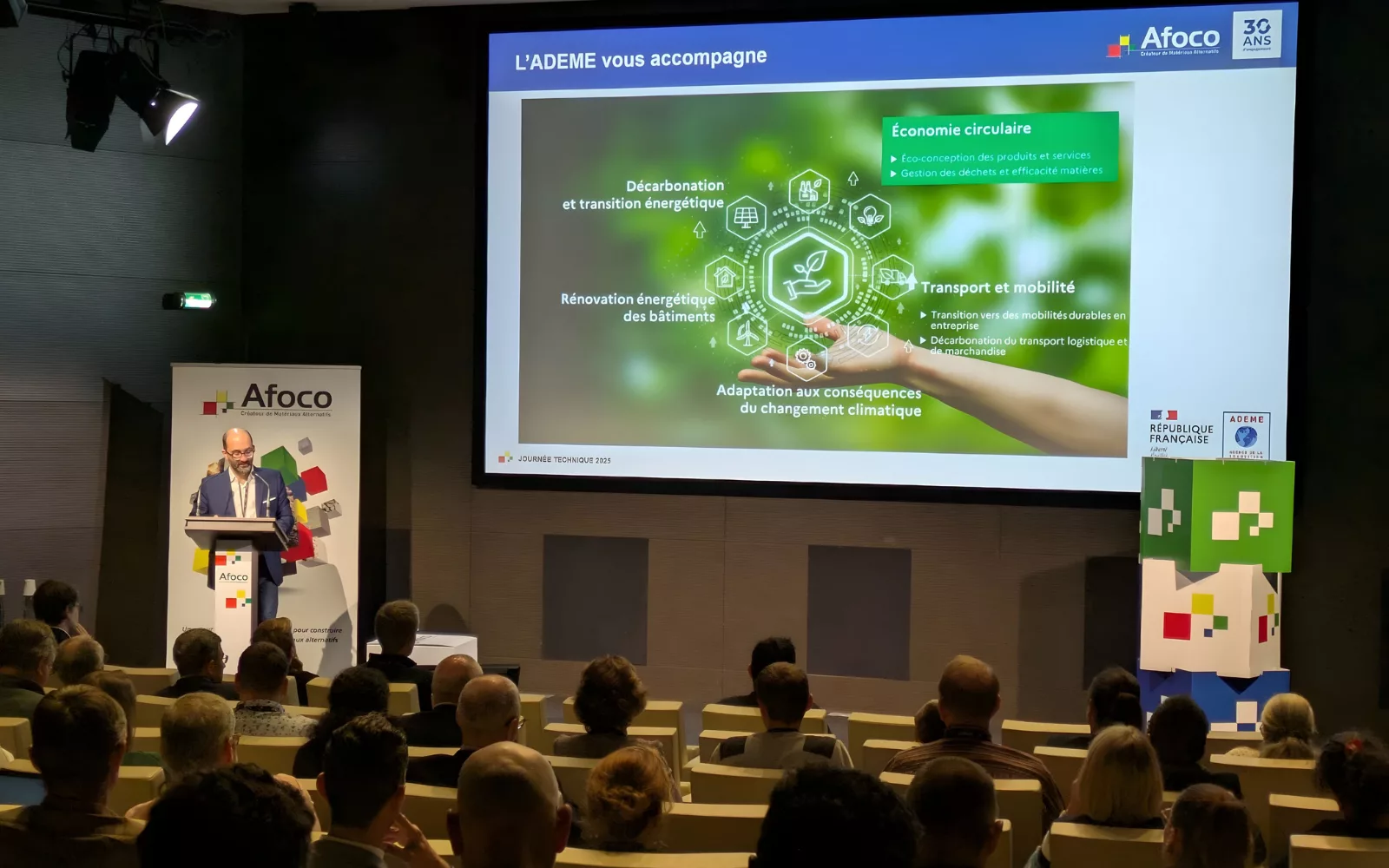
On the occasion of AFOCO 2025 Technical Day, Raphaël Guastavi, Deputy Director of Circular Economy at ADEMEpresented an in-depth analysis of the essential role of the circular economy in decarbonisation of enterprises.
Its intervention sheds light on the fact that reducing the carbon footprint of industrial sectors requires both energy efficiency and a profound transformation of our production, consumption and resource management models.
Circular economy: a structuring response to carbon and resource challenges
The circular economy is not limited to recycling. It involves reducing the use of raw materials, optimizing the use of products and reintegrating resources into the industrial cycle.
According to ADEME, this model is essential to simultaneously reduce:
- direct greenhouse gas emissions,
- imported emissions related to manufactured products,
- dependence on critical resources.
This change requires increased sobriety, but also a massive use of recycled materials, whose carbon footprint is significantly lower than that of imported virgin materials.
Access to resources: increasing vulnerability for businesses
Geopolitical tensions, rising global demand and the scarcity of certain raw materials are highly exposing industrial enterprises.
Sectors dependent on critical metals, fossil fuels or mineral materials are particularly affected.
The circular economy is then seen not only as an ecological approach, but also as a strategic response to:
- secure supply,
- limiting external dependence,
- strengthen industrial resilience.
A European vision: the circular economy at the service of declining emissions
The European Commission's work shows that circular practices could reduce between 189 and 231 million tonnes of CO2 equivalent per year.
The most significant results are:
- the steel sector, with a potential reduction from 64 to 81 Mt CO2eq/year,
- the plastics sector, with 75 to 84 Mt CO2eq/year.
These measures would also reduce fossil energy consumption by almost 5% on a European scale, improving energy security and reducing dependence on imports.
ADEME: a structured accompaniment to accelerate the transition
To support businesses, ADEME offers several methodological tools:
The ACT (Assessing Low Carbon Transition) methodology
It helps organizations to:
- develop a decarbonisation strategy aligned with global climate goals (ACT Step by Step),
- assess the relevance of an existing plan (ACT Assessment),
- anticipate the impacts of climate change on their activities (ACT Adaptation).
Sector Transition Plans (TPS)
ADEME provides a detailed methodological guide to support industrial sectors in the construction of their low carbon roadmaps.
The methodology Imprint Project
A multi-criteria approach to assess the full environmental impact of a project, from design to end of life, to ensure that it remains truly beneficial.
These tools, accessible online, enable companies to structure their transition and speed up the implementation of concrete actions.
Circular economy, a structural transformation already in progress
The ADEME presentation at the AFOCO 2025 Technical Day highlights a central message:
deep decarbonization of industry cannot be achieved without massive reliance on circular economy strategies.
By reducing dependence on raw materials, reducing imported emissions and stimulating local production, the circular economy is one of the most powerful levers to strengthen competitiveness while contributing to national and European climate goals.
🔗 View the full presentation
Find the full presentation on our website : Click here