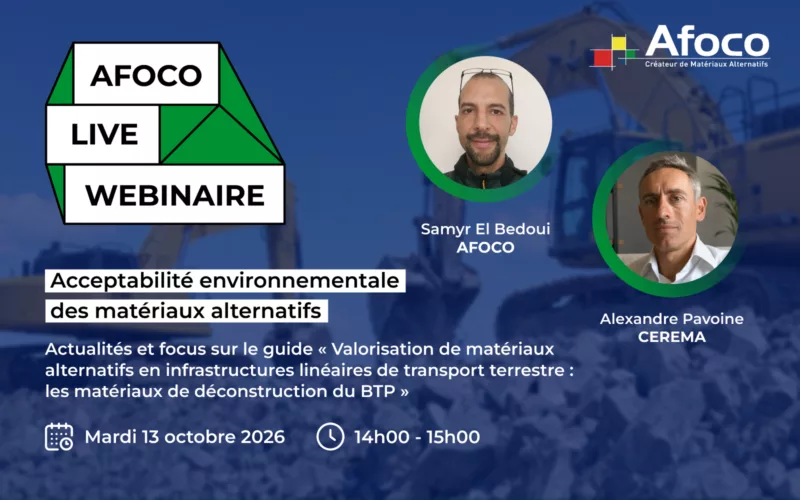
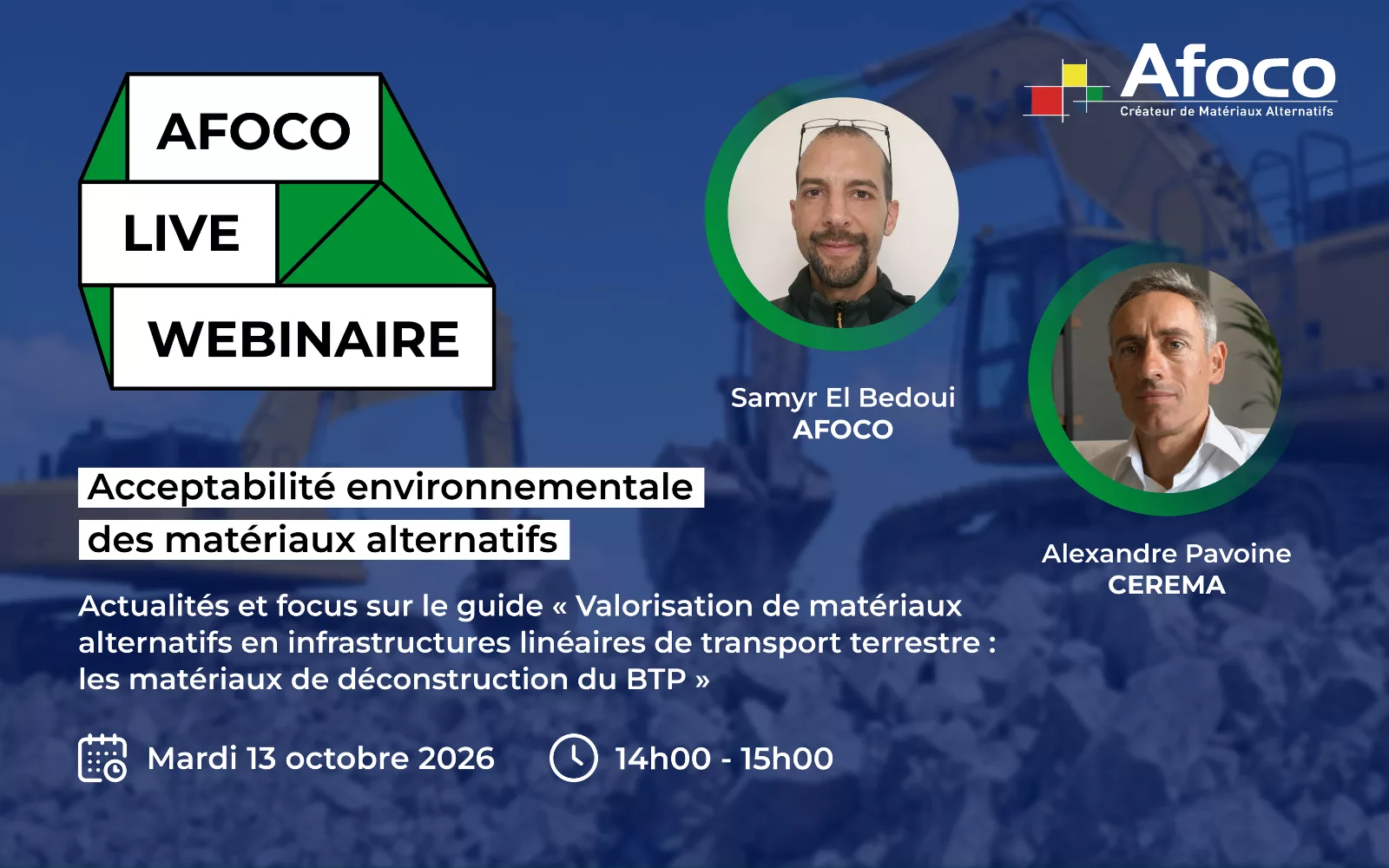
On Tuesday, 13 October 2026, AFOCO dedicated a webinar to the evolution of methodological guides for the development of alternative materials. On this occasion, the Cerema presented the main advances of the repositories, with a focus on the 2025 revision of the guide on linear land transport infrastructures and on the new perspectives offered by the guides dedicated to developments.
The publication in March 2011 of the general methodological guide to the Setra was a major first step. It provided a common framework for assessment, replacing case-by-case approaches, for the development of alternative materials in road technology.
The 2025 revision marks a new step, with an expansion of the scope of application and a strengthening of the requirements for material characterization, quality and traceability.
The 2025 revision: a wider scope for ground transportation infrastructure
One of the main developments is the shift from road to linear land transport infrastructures.
The methodological framework now covers a wider range of works, including:
- road infrastructure, such as roads and motorways;
- railway infrastructure and railways;
- bicycle lanes, soft links and facilities dedicated to active mobility, as well as related facilities provided for in the guide.
The areas of employment are also defined according to the conditions of use and exposure of materials. The categories T1, T2 and T3 distinguish between uses with watertight cover, uses with semi-permeable cover and uncovered structures, which are directly exposed to weather.
This makes it possible to adapt evaluation methods to different employment contexts, while maintaining a common methodological approach.
Enhanced quality and traceability requirements
The revision places greater emphasis on controlling health risks and traceability of alternative materials.
For T3 uses, a health risk assessment is required. These uses include uncovered embankments and hake, which are directly exposed to weather. The assessment must therefore take into account the exposure conditions specific to the works concerned.
Quality control is also based on two complementary devices:
- The environmental annex, a contractual document which specifies, inter alia, the source of the materials and the tests carried out on the lots.
- The Quality Control Plan (QMP), which oversees controls carried out by the producer or manufacturer, as well as on-site self-approval checks.
The guide also changes the characterization of environmental and health compliance. Depending on the conditions for the preparation of the materials and the intended uses, verification may cover incoming materials, developed materials or formulated materials.
Several adaptations also concern test protocols, certain parameters analysed and applicable limit values, in particular for certain metal anions and trace elements.
Finally, the benchmark specifies the procedures for verifying compliance, periodicity of checks, storage conditions and batch management rules.
A new step: the guides dedicated to the development
The webinar also highlighted the extension of the scheme to include development projects, with a complementary approach to linear infrastructure.
The two frames are distinguished mainly by the geometry of the structures and the exposure scenarios taken into account.
- The guide « Infrastructure » concerns continuous linear structures, such as road and rail tracks. The assessment of leachate transfers takes into account the linear geometry of the structures.
- The guide « Development » applies to surface, point or complex projects, such as Cooperative Development Areas (ACAs), activity parks, platforms and certain landscape developments.
This complementarity aims to better adapt environmental and health requirements to the diversity of projects, be they linear infrastructure or development.
A focus on the construction materials of the BTP
The webinar then addressed the guide « Valorization of alternative materials in linear terrestrial transport infrastructures: materials for deconstruction of the BTP », prepared by Cerema with the contribution of several actors in the sector, including AFOCO.
This guide sets out the general methodological framework for materials resulting from the deconstruction of the building and public works. The deposits concerned include:
- concrete;
- bricks, tiles and ceramics;
- glass;
- bituminous mixtures containing no tar;
- land and stones not containing dangerous substances;
- track ballasts meeting the conditions specified in the guide.
The aim is to define the conditions under which these materials can be valued in infrastructure, according to their characteristics and intended uses.
Three compliance options
The guide presents three options for verifying the environmental and health compliance of materials, based on their nature, development and use.
- Option 1: Incoming material verification: The characterization includes materials received prior to processing or processing.
- Option 2: verification of materials developed: controls are carried out on materials after their development. Where several granulometric fractions are produced from the same stock, the verification may, under the conditions laid down in the guide, cover only the finest fraction.
- Option 3: verification of the formulated material: this option refers to situations in which several materials are mixed to obtain a formulation for a given use.
In all cases, the mixture or formulation shall not be used to dilute non-compliant material to artificially meet environmental and health acceptability criteria.
The document also specifies how the results of analysis are to be processed: when several analyses are carried out on the same lot or on the production of the same period, the medians of the results are retained in accordance with the applicable provisions of the guide.
Changes in parameters and limit values
The benchmark provides for adjustments of parameters to be analysed and limit values according to the nature of materials and areas of use.
For concrete and mixed materials, the thresholds for salts and heavy metals change for T1 and T2 uses. Health parameters, including certain hydrocarbons and heavy metals, are also added for T3 uses.
For coatings, HC C10-C21 is removed and naphthalene is added.
These developments aim to adapt characterization to the properties of materials, exposure conditions and intended uses. They are part of a structured verification process designed to secure the development of the construction materials of the BTP.
Key points
The presentation recalls several fundamental principles of valorisation of alternative materials:
- the materials concerned must meet the conditions laid down in the methodological framework;
- environmental and health characterisation must be adapted to the materials and uses envisaged;
- quality and traceability requirements must be taken into account;
The assessment of environmental and health problems related to materials and their uses does not replace the geotechnical study, which is conducted in parallel.
The general approach is thus retained, with an integration of the health component for certain uses and the verification procedures specified in the guide on the construction materials of the BTP.
FOLLOW US

AFOCO
In SURSCHIST,
ZI La Croisette,
Rue Auguste Mariette
62300 LENS
contact@afoco.org
QUICK ACCESS
OUR OBJECTIVE
In order to achieve our goal of decarbonizing the BTP and industry sectors, we are developing innovative technologies, strategic collaborations and sustainable solutions.
FOLLOW US
AFOCO
In SURSCHIST,
ZI La Croisette,
Rue Auguste Mariette
62300 LENS
contact@afoco.org
QUICK ACCESS
OUR OBJECTIVE
In order to achieve our goal of decarbonizing the BTP and industry sectors, we are developing innovative technologies, strategic collaborations and sustainable solutions.
FOLLOW US
AFOCO
In SURSCHIST,
ZI La Croisette,
Rue Auguste Mariette
62300 LENS
contact@afoco.org
QUICK ACCESS
OUR OBJECTIVE
In order to achieve our goal of decarbonizing the BTP and industry sectors, we are developing innovative technologies, strategic collaborations and sustainable solutions.
Copyrights © Afoco 2026 • Legal information • Privacy Policy • Design: Studio LN