NMR
Recycling Northern Materials
53 rue Gabriel Péri 59273 FRETIN
03 20 41 57 00
www.materials.eiffageroute.com/recyclage-materials-north
Contact : DESSAUVAGES Patrick
E-mail: patrick.dessauveages@eiffage.com
Precursor of recycling of deconstruction site materials. NMR benefits from more than 30 years of experience in the recovery of bricks and concrete demolition as well as in their processing and upgrading into sand and aggregates 100% recycled in Public Works.
Designed to provide a guarantee of production that meets the sustainable development objectives of contractors and works, the processing and recovery processes developed by NMR ensure complete traceability of materials, from control of input composition to standardization of finished products and validation of their environmental neutrality. Sands and aggregates obtained may be called « 100% recycled », in line with the most demanding urban and industrial approach.
Key figures
- 240 000 tonnes of recycled raw materials each year
- 250 000 tonnes of recovered site materials
- 1800 tonnes of scrap produced by the steel industry
- 90,000 tonnes of sands and aggregates from public works
- 147 000 tonnes of products produced in a major plant
- 1200 tonnes of ultimate waste
NMR products 100% recycled
Since its creation, RMN has processed and recycled more than 10 million tonnes of bricks, tiles and concrete from deconstruction sites.
That is 4 million m3 or the equivalent of a 500 m high tower, based on a football field.
Extracts from the recovery materials and treated by NMR, concrete irons are reintegrated into the steel industry for the production of the highest quality steel.
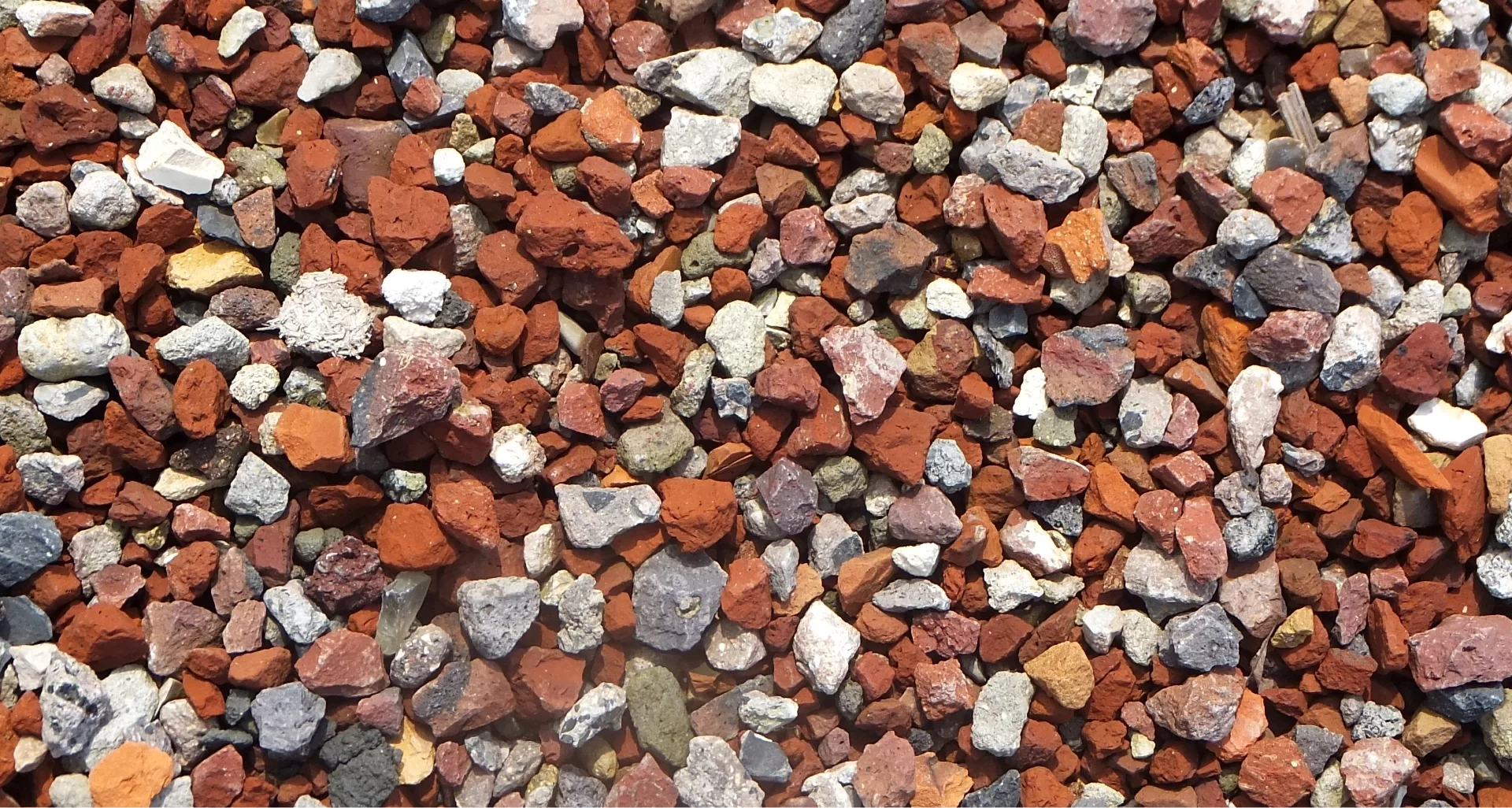
100% recycled NMR products, of varying particle size, substitute for products « natural » that Public Works uses for the composition of embankments, layers of shapes, laying beds and carriageways. They also have the advantage of a mass economy of around 10%, with comparable volume.
Thanks to its recomposition plant with binder input and 9 pre-dosers, NMR is able for Public Works to tailor-made and produce embankment, edge concrete and severe, at 450 tons/hour.
In the end, there are only 1200 tonnes of ultimate waste per year left in a classroom landfill.